
Lithuania, Music & Sound, 2026, in Berlin
Lina
Lapelytė
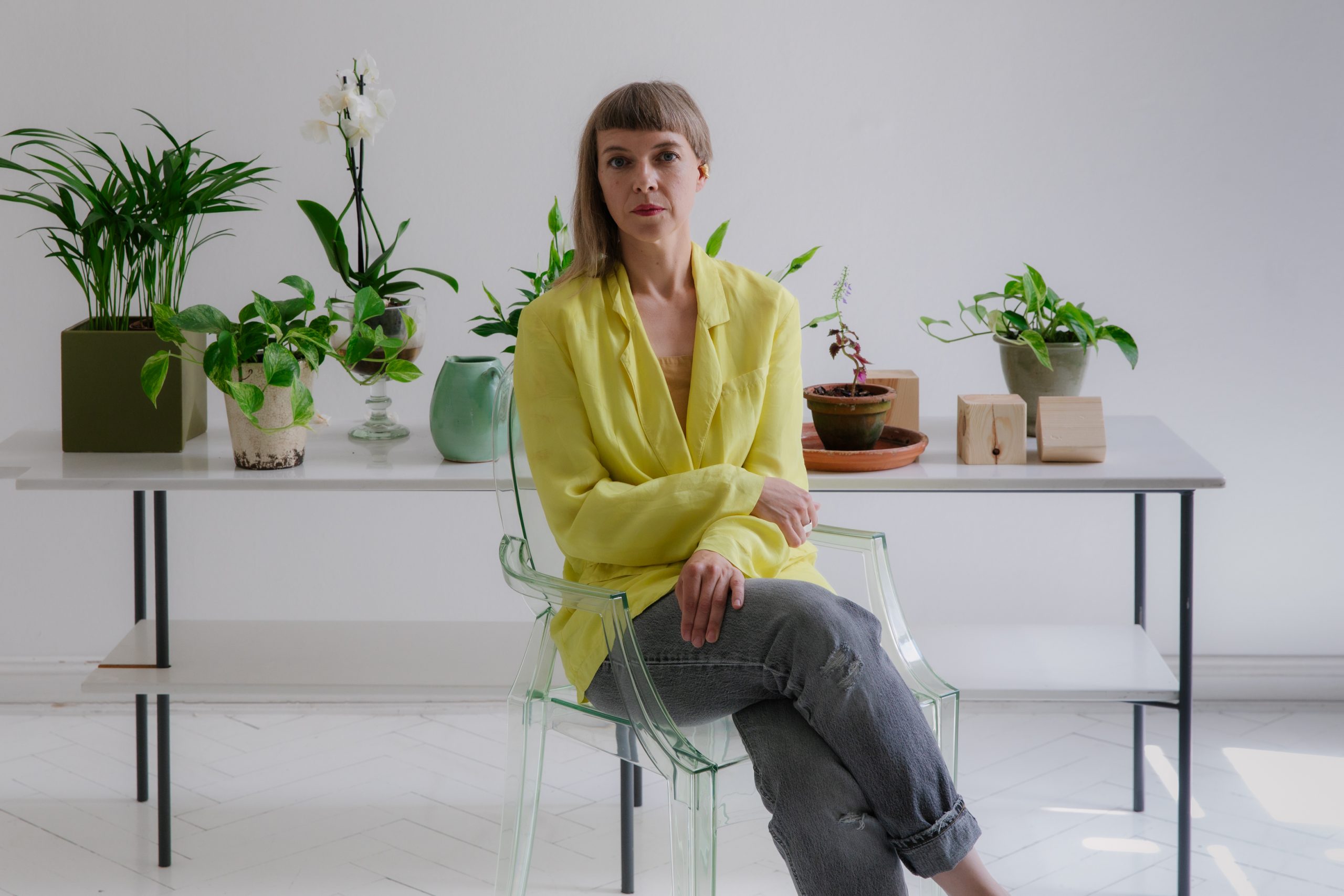
It may seem a bit odd to introduce one of the most acclaimed artists, musicians, and composers of our time with a memory of a seemingly insignificant moment, rather than a list of her achievements. But this small scene offers a far more revealing entry point into understanding who Lina Lapelytė (b. 1984 in Kaunas, Lithuania) is—how she works, and why her art resonates so deeply. (We can return to her accolades shortly.)
We were walking through a swamp in Lithuania Minor. Terpene-scented air drifted from bushes of Marsh Labrador tea lining the path—plants like wild rosemary that make your head spin a little, their leaves brushing our clothing as we moved forward. We were a tangle of six adults and as many small children, all of us heading toward a lookout tower rising above the bogs. Once there, we were met with an expanse of wetlands glowing in the sunset. While I was catching my breath, Lina turned to the children and said, “Vaikai—now, let’s all be quiet for one minute. Listen.”
This was before the Lithuanian Pavilion won the Golden Lion for Sun & Sea at the 58th Venice Biennale in 2019, before solo exhibitions at Lafayette Anticipations, before public sculptures such as Copper Lick (2024)—a monumental, parabolic sound box installed along the Isar in Munich, designed to catch, amplify, and fold the city’s bell tones and ambient noise into a shared listening space—before the stream of invitations to biennials around the world, most recently Performa in New York. The moment contains something essential to understanding Lina’s work: her attention to her performers and her audience, her attunement to place, and the conviction that listening—really listening—is the key.
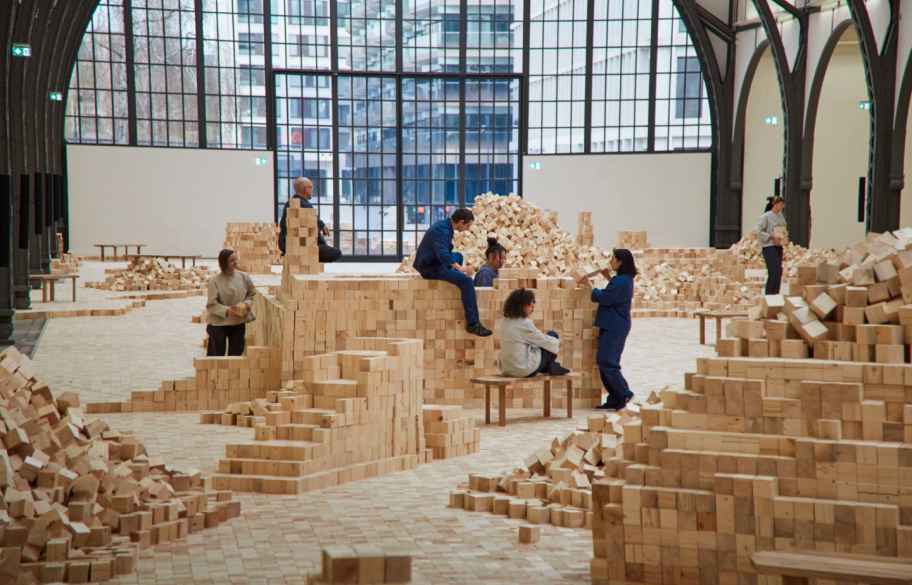
Lapelytė—whose practice spans performance, video, film, composition, sculpture, and installation—has created a long list of works that give voice to the unacknowledged or the unseen. Pieces such as Currents/Instructions for the Woodcutters (merging manual labor and chanted instruction into a meditation on resource extraction, 2021); What Happens with a Dead Fish? (an unsettling portrait of environmental imbalance, sung atop a pool-like stage, 2021); and Sun & Sea (a languid artificial beach where sunbathers sing of ecological collapse) grapple with global calamities, while others give space to historically marginalized protagonists: women, children, animals. Repeatedly, Lapelytė has involved those who fall outside normative expectations of “good,” “successful,” or “proper” in her practice. She has made a piece for performers who cannot hold a tune (Study of Slope, aka The Mutes, 2022 ongoing), one for female voices considered “too low” (Hunky Bluff, 2014), and one for bodies deemed “too old” (Pirouette, 2018), too feminine, or not feminine enough. Her practice challenges our perceptions and asks what and who we choose to hear—and what remains ignored.
Often, she also welcomes performers not typically embedded in the art world. In The Speech, for example, a choir of children delivers fragmented howls and growls that, in the absence of language, expose the limits of speaking when stripped of adult polish.
Over time, certain references have receded—pop-cultural motifs like those in Candy Shop (2013) rarely surface today. Others—particularly those that probe the structures and expectations of music itself (Ladies, 2015, Hunky Bluff, Study of Slope)—continue to shape her polyvocal responses to urgent issues: climate change, global anxiety, exhaustion. Though the topics feel heavy, Lapelytė’s responses do not. Recent works—In the Dark, We Play, Kosmiczny Dom (both 2015), and her forthcoming Chanel commission for Hamburger Bahnhof (2026/27)—search for collectivity and meaning in a world growing ever more absurd and polarized. They center fleeting, unassuming moments of joy—small episodes that soothe the soul—helping us to listen up, wander into a swamp, and let the world tune into itself.
Yana Foqué,
is a Belgian curator, a mom, an editor, a writer, and an ok cook, serving as Artistic and Executive Director of Grazer Kunstverein since 2026.