
USA, Visual Arts, 1976
Dorothy
Iannone
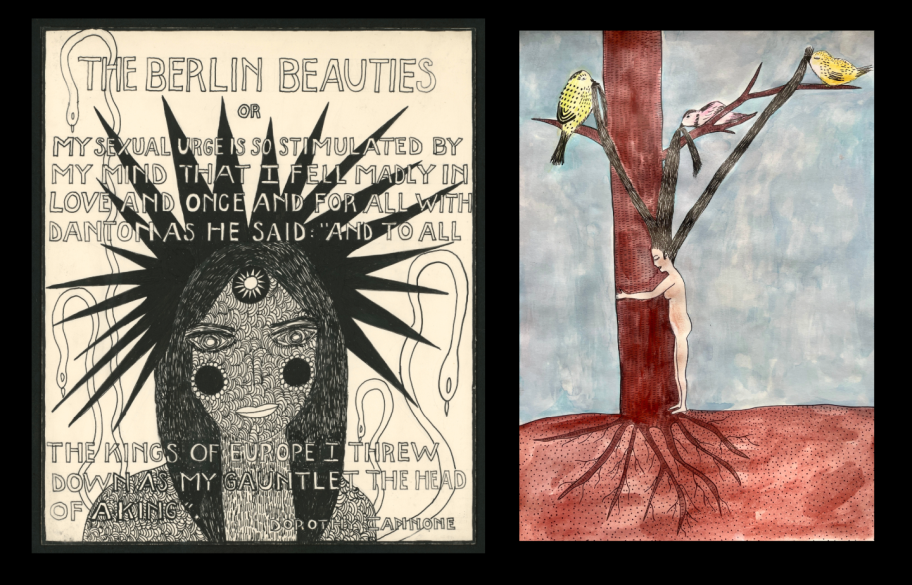
Dorothy Iannone (b. 1933 in Boston, Massachusetts, d. 2022 in Berlin) lived and worked in Berlin since 1975/76, when she came to the city as a fellow of the DAAD Artists-in-Berlin Program (BKP). Self-taught as an artist, she began painting in an Abstract Expressionist style in 1959 and later turned to ornamental, all-over structures, drawing inspiration from her extensive travels. A journey to Iceland in 1967 changed Iannone’s life: it was here that she met the Fluxus artists Emmett Williams and Dieter Roth, and decided to abandon her privileged life in New York and go and live with Roth, first in Reykjavik, then in Basel, London, and Düsseldorf. This deep artistic and personal connection—her everyday life and sexual relationship with her “muse” Dieter Roth—became the main subject of her work, as can be seen, for example, in her intimate Dialogues (1967–68). Even after she and Roth separated in 1974, Iannone continued to produce storyboards in which texts and images are combined. One such work is the artist’s book The Berlin Beauties (1977–78), an illustrated love poem she created here.
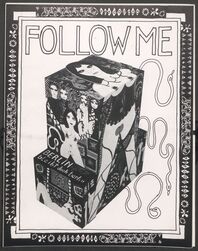
In the few exhibitions held during the 1970s and 80s that were dedicated specifically to women artists—such as Künstlerinnen International 1877–1977 at the Neue Gesellschaft für bildende Kunst (nGbK) in West Berlin in 1977—Iannone is noticeably absent. The joyful, sensuous figuration in her paintings and collages did not fit into the dominating categories of the time and was often dismissed as folkloristic, naive, or insufficiently feminist—despite or perhaps because of the fact that her works portrayed liberated female sexuality. In collaboration with the Artists-in-Berlin program, Iannone had solo exhibitions at Haus am Lützowplatz (1978; accompanied by the artist’s book Follow Me with a recording of her singing) and at Galerie ARS VIVA! (1982; accompanied by the artist’s book Censorship And The Irrepressible Drive Toward Love and Divinity, which deals with her experiences of censorship). Like that of many other women artists, Iannone’s work was not “rediscovered” by younger curators and galleries until late in her career; it gained recognition above all following her participation in the 4th Berlin Biennale in 2006. Her art is characterized not only by its sharp, self-reflexive sense of humor, but also by its unashamedly sensuous beauty. Even though male and female genitals appear in almost every image—whereby the bulging labia are jokingly reminiscent of “big balls”—and many of her works show cunnilingus, fellatio, and intercourse in different positions, the depictions are so highly stylized that they transcend any notion of pornography.
In 1997 Iannone had a solo exhibition at the nGbK in Berlin; in 2009 she presented the series Movie People at the New Museum, New York; and in 2013 she had shows at the Camden Arts Centre in London and at Palais de Tokyo in Paris. In 2014 the Berlinische Galerie presented a groundbreaking retrospective of Iannone’s oeuvre—including videos, films, objects, “Singing Boxes” from the 1970s, numerous artist’s books, and large-format canvases such as The Next Great Moment In History Is Ours (1970)—that underscored her intermediality. The radical subjectivity with which she unconditionally intermingles art and life in her depictions makes Dorothy Iannone’s practice particularly relevant for younger generations of artists and viewers in the present day.
Text: Eva Scharrer
Translation: Jacqueline Todd
Past
Related Archival Files
|
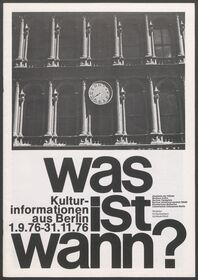
Was ist wann? 7. Kulturinformation aus Berlin vom 1.9.76-31.11.76 |
El Sharouni, Youssef Graham, Dan Hamburger, Michael Iannone, Dorothy Mikkawy, Abdel-Ghaffar Hassan Kawara, On |
1976 | Text: Drucksache |
|
Iannone, Dorothy | 1978 | Text: Drucksache | |
|
Armando Cha, Ouhi Dias, Antonio Mayer Harrison, Helen Harrison, Newton Iannone, Dorothy Knížák, Milan Kolíbal, Stanislav Rickey, George Trasov, Vincent Wasko, Ryszard Williams, Emmett |
1988 | AV: Video |