
Italy, Visual Arts, 1968
Piero
Dorazio
Piero Dorazio (b. 1927 in Rome; d. 2005 in Perugia) spent six months in Berlin in 1968 at the invitation of the DAAD Artists-in-Berlin Program (BKP). The Italian painter had originally been influenced by the Futurists, but their right-wing tendencies led him to distance himself from this group. Dorazio created abstract art in the style of Constructivism, Color Field painting, and lyrical abstraction. In 1946 he joined the Arte Sociale group in Rome, and in 1947 he co-founded Forma 1, a group of abstract painters whose manifesto rejected the local tradition of Novecento Italiano and the Scuola Nuova, and opposed Socialist Realism. They sought to renew Italian painting in the spirit of European modernism and to reclaim abstract painting from the Futurists. In 1947 Dorazio was awarded a stipend from the French government to study in Paris, and in 1950 he helped to found L’Age d’Or, a gallery/bookstore in Rome and Florence. During the 1950s he spent time living and teaching in the United States, where he met Abstract Expressionist artists such as Mark Rothko, Robert Motherwell, and Barnett Newman. In 1959 Dorazio took up a teaching position at the University of Pennsylvania, where he founded the Institute of Contemporary Art in 1963 and was appointed professor in 1968.
In his abstract painting Dorazio developed systems based on pure primary colors, which he superimposed and interwove in stripes, lines, fields, and planes. During his time in Berlin, he employed the basic formal elements of systematically overlapping bands of color, grids, and bars to develop various resolutions of three simple pictorial themes: superimposed parallel bands of two or more colors; sequences of curved bands of color that recall archaic flat wave patterns; and forms resembling inlays or puzzle pieces that are combined to produce much larger bands. In 1969 Piero Dorazio had a solo exhibition at the Haus am Waldsee, organized by the Artists-in-Berlin Program, in which the paintings he had created in Berlin were juxtaposed with works from the previous ten years. A catalogue was published to accompany the exhibition.
Piero Dorazio participated multiple times in the Venice Biennale (1952, 1958, 1960, 1964, 1966, and 1968) and twice at documenta (1959 and 1964).
Text: Eva Scharrer
Translation: Jacqueline Todd
Related Archival Files
|
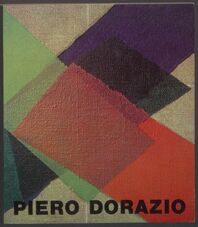
Dorazio, Piero | 1969 | Text: Drucksache | |

|
Akrithakes, Alexes Armitage, Kenneth Black, David Castillo, Jorge Cravo, Mario Dorazio, Piero Engelman, Martin Fangor, Wojciech Goeschl, Roland Haubenstock-Ramati, Roman Herbert, Zbigniew Iida, Yoshikuni Ikeda, Masuo Kotík, Jan Kotik, Jan Remotti, Remo Vedova Emilio Sekal, Zbynek: Sekal, Zbynek Scott, William |
1970 | Text: Drucksache |