
Spain, Visual Arts, 1975
Eduardo
Arroyo
Eduardo Arroyo (b. 1937 in Madrid; d. 2018 in Madrid) was a fellow of the DAAD Artists-in-Berlin Program (BKP) in 1975/76. He came to West Berlin with his wife, the photographer Grazia Eminente, although she was not officially a BKP fellow. Arroyo was a painter, sculptor, and graphic artist who started his career working as a journalist, but left Spain in 1958 in protest against the Franco regime. Self-taught as an artist, he took up a niche position by deciding to pursue figurative painting at a time when abstraction was the dominant force in Paris and elsewhere. Arroyo’s simplified figurative compositions are filled with easily legible references to historic events and people in public life; above all, they quote images from art history, often in a defamiliarizing and ironic manner. The renowned Berlin critic Heinz Ohff described his practice as a “link between Pop art and critical realism.” Prior to his period of residency, Arroyo had already been active in Berlin and other cities in West Germany as an artist and set designer: in 1964 his work was included in an exhibition at Galerie Benjamin Katz; and in 1971 he had a solo show at the neue Gesellschaft für bildende Kunst, where he exhibited Spanish-Republican panel paintings. Above all, however, he became known in Berlin through his collaboration with Klaus Michael Grüber on various theater and opera productions, among others at the Berlin Schaubühne. In 1974 Arroyo was appointed to the jury in the art section of the Venice Biennale.
During his time in Berlin, Arroyo discovered a new material with which to create works that are to be categorized as (seemingly apolitical) Pop art: black grooved or studded rubber of the kind used to make tires or cover floors, for example in waiting rooms or airport corridors. Arroyo used cut-up sheets of rubber with varying surfaces to create relief-like panel pieces modeled on oriental carpets; three-dimensional carpet objects; and cut-out animal reliefs reminiscent of the Egyptian statues of dogs and cats displayed in the Egyptian collections of museums in Berlin’s Charlottenburg and Dahlem districts. In 1976 these monochrome works were presented along with works by Grazia Eminente and Chihiro Shimotani in the exhibition Kreuzberg 1976, organized by the Artists-in-Berlin Program at the Akademie der Künste in West Berlin. Above all, Eminente’s black-and-white photographs—which also provided the title of the exhibition—entered into a dialogue with Arroyo’s rubber reliefs. Her photographs of museum displays in ethnological collections were juxtaposed with images of Turkish shop-window displays in Kreuzberg and oriental bazaars: an elderly woman wearing a headscarf appeared next to the bust of Nefertiti, baklava next to pizza, Berlin next to Istanbul. In their various interpretations of high and low orient, Eminente’s photographs corresponded with Arroyo’s rubber pictures. Both artists’ contributions are documented in the catalogue Kreuzberg 1976, published by the Artists-in-Berlin Program, and in 1978 they were shown by the Fondation Nationale des Arts Graphiques et Plastiques in the exhibition En souvenir de Kreuzberg 1976 at the Hôtel Salomon de Rothschild in Paris.
Following his return to Spain in 1976, Eduardo Arroyo was honored by his native country with a major retrospective and his Spanish citizenship was restored. In 1982 he was awarded the country’s National Award for Plastic Arts.
Text: Eva Scharrer
Translation: Jacqueline Todd
Related Archival Files
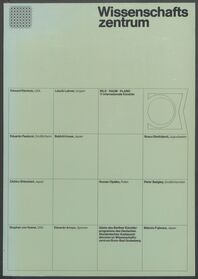
|
Arroyo, Eduardo Dimitrijevic, Braco Fujiwara, Makoto Huene, Stephan von Inoue, Bukichi Kienholz, Edward Lakner, László Opalka, Roman Paolozzi, Eduardo Sedgley, Peter Shimotani, Chihiro |
1976 | Text: Drucksache | |
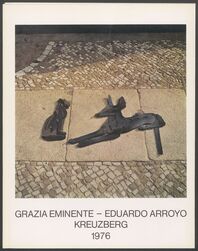
|
Arroyo, Eduardo | 1976 | Text: Drucksache | |

|
Was ist wann? 5. Kulturinformationen aus Berlin vom 15.2. bis 15.5.1976 |
Arroyo, Eduardo Sedgley, Peter Prent, Mark Buren, Daniel Baratella, Paolo |
1976 | Text: Drucksache |
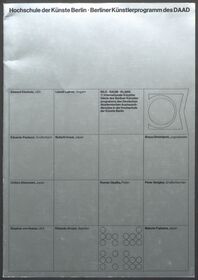
|
Arroyo, Eduardo Dimitrijevic, Braco Fujiwara, Makoto Huene, Stephan von Inoue, Bukichi Kienholz, Edward Lakner, László Opalka, Roman Paolozzi, Eduardo Sedgley, Peter Shimotani, Chihiro |
1977 | Text: Drucksache |